
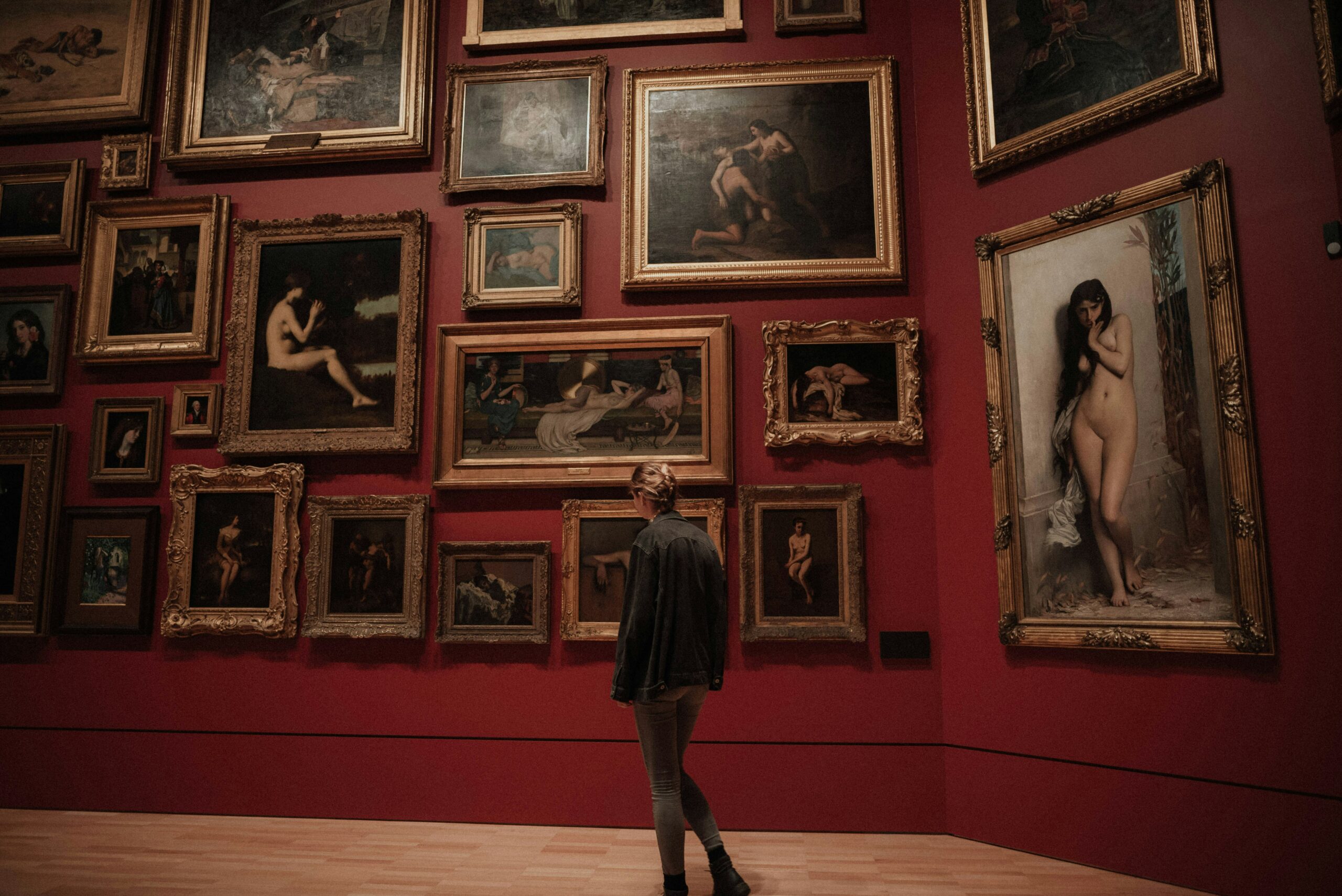
Eroticism has been part of art for centuries. The human body has been painted, sculpted, staged, and interpreted. Yet erotic art has never merely been an expression of beauty or physical attraction. It has always also reflected social ideas about intimacy, shame, power, identity, and freedom. What may be shown, what provokes, and what remains taboo constantly changes alongside society’s perception of sexuality and physicality.
While the naked body in classical art was often idealized and aestheticized, this relationship began to fundamentally change in modern and contemporary art. The body is no longer merely observed but actively used: as a medium, as an expression of vulnerability, as a political statement, or as an immediate physical experience. Eroticism no longer emerges exclusively through aesthetics, but increasingly through intimacy, irritation, closeness, and the conscious confrontation with social boundaries.
Performance art in particular radically shifts the perspective on sexuality. Artists directly incorporate their own bodies into their works and make the audience themselves part of the experience. Questions of control, consent, identity, objectification, and bodily autonomy are no longer discussed theoretically but made physically tangible. Eroticism no longer appears as a distant image, but as a relationship between body, space, and perception.
Within this blog post, we take a look at artists who make eroticism visible in very different ways and thereby open social, political, and personal perspectives on sexuality. From feminist performance art and radical body stagings to spiritual and queer forms of expression, erotic art reveals how diverse its meanings can be today and why it continues to provoke, fascinate, and spark debate.
From Idealized Nudity to Lived Bodily Experience
For many eras, the erotic body in art was not portrayed as an everyday physical reality. Artists preferred to depict ideals with smooth, harmonious forms, always embedded with symbolic meaning ¹. Whether in ancient sculpture, Renaissance painting, or later academic nudes, the naked body was often integrated into a narrative or mythological framework. This was intended to make it “explainable” and therefore socially acceptable ². Eroticism was rarely immediate. It was mediated, stylized, and tamed through the artistic framework ³. The gaze upon the body remained distant and was replaced by aesthetic contemplation rather than genuine experience ⁴.
With the development of modern and contemporary art, this relationship began to shift fundamentally. The body lost its role as a mere motif and increasingly became the material of artistic exploration itself. As a result, the function of eroticism also changed: it became less representation and more situation. This is precisely where performance art becomes central. It breaks with the idea of safe, distant observation and shifts the focus into real space. The body becomes action, making it vulnerable, present, and immediately experienceable. This creates a new form of eroticism that no longer functions solely through aesthetics, but through proximity, irritation, and physical presence.
Classical art history often encoded and symbolically conveyed eroticism. In contrast, modern performances attempt to communicate eroticism as a social experience between artist and audience. This shift makes clear why performance art stands at the center of this discussion: it presents eroticism not as an image, but as a relationship.
The Body as a Radical Medium
One of the central figures of this development is the Serbian performance artist Marina Abramović. Her work explores physical and psychological limits, often focusing on the tension between intimacy and control. Pain is the constant element throughout her work.
In one of her earliest performances, Imponderabilia, the artist and her partner Ulay stood naked opposite each other at the entrance of an art gallery in Bologna. Visitors were forced to enter the museum by passing between two naked bodies, and they had to decide how they wanted to navigate this intimate space. Sexuality does not appear explicitly here, but as a social and bodily tension: What does closeness mean? Where does intrusion begin? How does an audience react to naked presence in public space? These were precisely the questions the artist duo consciously addressed. The performance made the visitors themselves part of the artwork and confronted them with their own vulnerability, shame, and bodily perception.
Feminist Perspectives: The Body as Resistance
While Abramović explores more universal bodily boundaries, other artists use sexuality deliberately as a feminist statement. The Austrian artist VALIE EXPORT radically questioned the objectification of the female body in cinema as early as the 1960s. In Tap and Touch Cinema, the female body is actively brought into public space and made directly experienceable there. For this performance, she strapped a box around her chest, and visitors no longer merely saw a woman’s body projected onto a screen but could interact with it directly.
On the one hand, this removed the distance between viewer and artist; on the other, it highlighted the objectification of women in society at the time. In a provocative yet subtle way, she reveals what lies behind the voyeuristic gaze in film: the desire for control, intimacy, and bodily availability.
Pain, the Body, and Radical Intimacy

The confrontation becomes even more immediate with artists such as Ron Athey. His works combine sexuality with pain, physicality, and spiritual transcendence. In his performances, the body becomes the boundary between life and vulnerability. Blood, skin, and physical strain are not merely shock elements, but part of an intense engagement with marginalization, queer identity, and social exclusion.
Artists such as Franko B and the artist duo Bob Flanagan and Sheree Rose work with similar intensity, intertwining their BDSM lives with illness and intimacy. Here, sexuality is understood as a complex experience of control, surrender, and emotional closeness.
BDSM is not merely an artistic or theoretical concept, but also a practice expressed in many different forms. At its core are communication and the conscious exploration of dynamics such as control, trust, and surrender. What is often reduced or misunderstood from the outside is, in practice, a multifaceted field shaped by boundaries and mutual consent.
If you would like to learn more about BDSM, its foundations, and its various forms, you can find a detailed overview in our blog. There we explain what lies behind the term and how the different practices can be categorized, from the basics to more advanced forms.
Sexuality as Spiritual and Political Practice
A particularly multilayered approach can be found in the work of Annie Sprinkle, who left behind her career as a porn actress in order to redefine sexuality as educational, spiritual, and empowering. Her works, including the well-known Public Cervix Announcement, deliberately break boundaries of shame and shift the perception of the female body from objectification toward self-determination. During the performance, she inserted a speculum into herself and invited the audience to observe her cervix. Her goal was to demystify and normalize the female body.
Identity, Transformation, and the Dissolution of Boundaries
Artists such as Genesis P-Orridge also radically challenge the boundaries of body and sexuality. The “Pandrogyne” movement aimed to physically transform together with one’s partner in order to create a new, shared identity. Sexuality here is not understood as a private experience, but as a process of dissolving individual boundaries and a form of existential fusion.
Sexuality as a Voice of Feminist Self-Determination
The American artist Carolee Schneemann is still regarded as one of the most important voices in feminist performance art. In her iconic 1975 performance Interior Scroll, she radically connected body, language, and sexuality. During the performance, Schneemann pulled a scroll from her vagina and began reading from it. What initially appears provocative was above all a conscious statement against the centuries-long reduction of the female body to a passive object of male observation.
By literally allowing language to emerge from her own body, she challenged traditional power structures: the female body was no longer merely observed, but became a source of knowledge, expression, and authority. This is precisely where the social power of her work lies. In Schneemann’s art, sexuality appears as a self-determined expression of identity, experience, and creative power.
Eroticism in Museums and Exhibitions
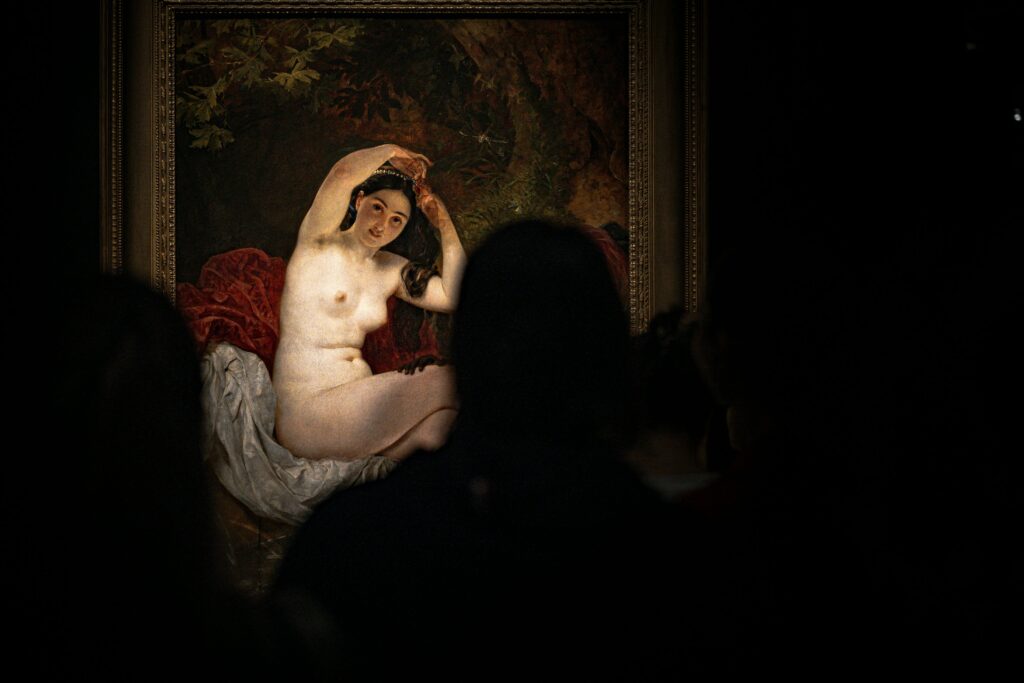
Erotic art is no longer confined to private collections or provocative individual works. International museums and exhibitions are now increasingly dedicated to the interplay of body, sexuality, and society. Particularly well known is the Museu de l’Eròtica in Barcelona, which presents the history of erotic representation from antiquity to the present day. Alongside classical paintings and sculptures, visitors can also find photographs and cultural objects from different eras. The Museum of Erotics and Mythology in Brussels similarly combines erotic art with mythological and historical perspectives. The exhibition demonstrates how closely eroticism has been linked to religion and social ideas throughout the centuries.
A more modern approach is offered by the Erotic Art Museum. Contemporary art forms, photography, and installations take center stage there. Themes such as identity, gender, and sexual freedom play a central role. In addition, major art institutions regularly address the topic through temporary exhibitions. Artists such as Egon Schiele, Gustav Klimt, and Félicien Rops are repeatedly presented in the context of eroticism, physicality, and social taboos. This demonstrates that erotic art has long become an established part of art historical and social debates.
In the United States, there is a counterpart in the form of the Museum of Sex on Fifth Avenue in New York. The museum aims to preserve and communicate the history, development, and cultural significance of human sexuality. Through changing exhibitions, it seeks to present visitors with the latest research findings.
The exhibition “SEX NOW,” which took place at the NRW-Forum Düsseldorf from September 2025 to May 2026, also addressed the topic of sexuality in all its facets in a contemporary way and presented, through around 400 works from art, photography, design, film, and pop culture, how ideas of the body, desire, and intimacy have changed and been renegotiated. The exhibition ranged from historical references and artistic positions to current social debates on sexual self-determination, diversity, and body image. It understood sexuality not as a taboo or niche topic, but as a central aspect of cultural reality, inviting visitors to question their own perspectives and develop new ways of thinking about intimacy and social norms.
Conclusion: Eroticism in Art Is Always Social Criticism
Through their works, these artists demonstrate the diversity of ways sexuality can be represented. Their art reflects social structures and aims to challenge them. Today, sexuality is rarely merely decorative. Rather, it functions as provocation, political gesture, or intimate boundary experience. It is confrontational, physical, and often deliberately uncomfortable. Modern erotic art forces us to reflect on our own ideas about the body, intimacy, shame, and desire. In art, the body is never just a body. It is always also a statement.
FAQ: Sexuality and Eroticism in Art
Why does sexuality play such an important role in art?
Sexuality is closely connected to identity, power, and social norms. Art uses it to evoke emotions and make social issues visible.
What distinguishes erotic art from pornography?
Erotic art usually carries an artistic or social message. Pornography is primarily intended to produce sexual arousal.
Why is the body so important in performance art?
The body itself becomes the medium of art. Through this, artists make themes such as intimacy, pain, and vulnerability directly experienceable.
What role does feminist art play?
Feminist artists challenge the objectification of the female body and present sexuality as an expression of self-determination.
Why do many works seem provocative?
Provocation is often used to critically question taboos, social norms, and society’s treatment of the body and sexuality.
Sources
¹ Kenneth Clark: The Nude: A Study in Ideal Form. Princeton University Press, 1956.
→ Foundational work distinguishing between the idealized “nude” and the real body image.
² James Hall: The World as Sculpture: Renaissance Relief Sculpture 1400–1530. Chatto & Windus, 1999.
→ On the mythological and narrative embedding of the body during the Renaissance.
³ Lynda Nead: The Female Nude: Art, Obscenity and Sexuality. Routledge, 1992.
→ On the cultural “framing” and control of eroticism in the nude.
⁴ John Berger: Ways of Seeing. BBC & Penguin, 1972.
→ On the distant and objectifying gaze toward the female body in the Western artistic tradition.