

Healthy eating, regular exercise, mindful body care and mental wellbeing have become natural parts of everyday life for many women. Yet despite the growing attention we pay to our overall wellbeing, one important aspect is often overlooked: intimate health. Intimate wellbeing is an essential part of our quality of life and deserves attention at every stage of life.
During perimenopause and menopause in particular, hormonal changes can have a noticeable effect on intimate health. As oestrogen levels decline, the skin and mucous membranes can become drier, thinner and more sensitive. These changes may cause discomfort not only during sexual activity but also in everyday life. Recognising what is happening and adapting intimate care to individual needs can therefore make an important difference.
Suitable medical lubricants offer one way of addressing vaginal dryness. Products of the pjur med range are intended to relieve vaginal dryness and are suitable for daily use. They can therefore help ease dryness-related discomfort and support intimate wellbeing, even independently of sexual activity.*2-4
Dr. med. Britta Kühlmann also emphasises that intimate health encompasses far more than sexuality. As a medical doctor and plastic and aesthetic surgeon, she takes a holistic approach to medicine, giving equal consideration to physical health, individual needs and personal wellbeing. During (peri)menopause, she believes it is particularly important to help women understand the changes taking place in their bodies and encourage them to give their intimate health the attention it deserves.
As she explains: “Intimate health should receive just as much attention in everyday life as any other part of the body. When we understand our own needs, we are better able to talk about changes early on and consider what kind of support is right for our individual circumstances.”
Why Intimate Health Is Part of Personal Self-Care
Self-care is not simply about looking after physical and mental health. It also means paying attention to sensitive areas of the body that are often overlooked. Intimate health is one of them, and it involves much more than the absence of discomfort. How we feel in our bodies, how we respond to intimate needs and whether we can experience intimacy without unpleasant sensations all play an important role.
It is worth distinguishing between intimate hygiene and intimate care. Gentle cleansing helps keep the external intimate area clean, while intimate care goes a step further. It takes individual needs into account and, where appropriate, may include targeted measures to relieve discomfort and support intimate wellbeing.
This is precisely the idea behind intimate care: rather than paying attention to intimate health only when problems arise, we can recognise it as a natural part of looking after ourselves. That does not require elaborate rituals or a collection of different products. What matters is developing an awareness of our bodies and being willing to respond to their needs.

When Intimate Needs Change During Menopause
The hormonal changes associated with perimenopause and menopause can affect intimate wellbeing in different ways. Alongside reduced natural vaginal lubrication, women may experience dryness and increased sensitivity of the skin and mucous membranes. The first blog post in our series with Dr. med. Britta Kühlmann explores these physical changes in greater detail and explains how they can affect intimate health.
Their effects on everyday life vary considerably. Some women primarily notice uncomfortable friction or pain during sexual activity, while others experience dryness, burning or heightened sensitivity during ordinary movement or physical exercise. These symptoms can affect quality of life and deserve to be taken seriously.*1
“Not every change in the intimate area is automatically caused by menopause. Dryness, burning or pain can have a range of underlying causes. That is why persistent symptoms should be assessed by a medical doctor rather than simply accepted as a normal consequence of hormonal changes,” explains Dr. med. Britta Kühlmann.
Lubricant in Everyday Life: When Regular Use May Be Helpful
Lubricants are often associated primarily with sexual activity. Yet suitable medical lubricants can also provide valuable support beyond intimate moments. In cases of vaginal dryness, they may help reduce uncomfortable friction, relieve symptoms and improve everyday intimate comfort.
The hormone-free lubricants in the pjur med range are Class IIb medical devices*5 intended to relieve vaginal dryness. As they are also suitable for daily use, they can be incorporated into a personal intimate care routine whenever needed.*² This does not mean that everyone needs to use lubricant every day. The frequency of use should depend on individual symptoms, needs and how well the product is tolerated.
Finding the Right Formulation for Your Needs
Choosing a suitable lubricant depends on several factors, particularly individual needs, ingredients and personal tolerance. Water-based and silicone-based lubricants have different properties, offering different ways to ease dryness-related discomfort and support intimate wellbeing.
Water-based lubricants are known for their light texture. They complement natural lubrication and provide additional moisture to the skin and mucous membranes. This can help reduce uncomfortable friction and ease symptoms associated with vaginal dryness, both in everyday life and during sexual activity. Their moisturising properties also make suitable formulations an option for regular use as part of a mindful intimate care routine.
Silicone-based lubricants, by contrast, form a smooth, particularly long-lasting lubricating layer on the surface of the skin and mucous membranes. This helps reduce friction and remains effective for an extended period without frequent reapplication. Especially when vaginal dryness is more pronounced, this lasting lubrication may help relieve uncomfortable friction and associated symptoms during intercourse as well as in everyday life.
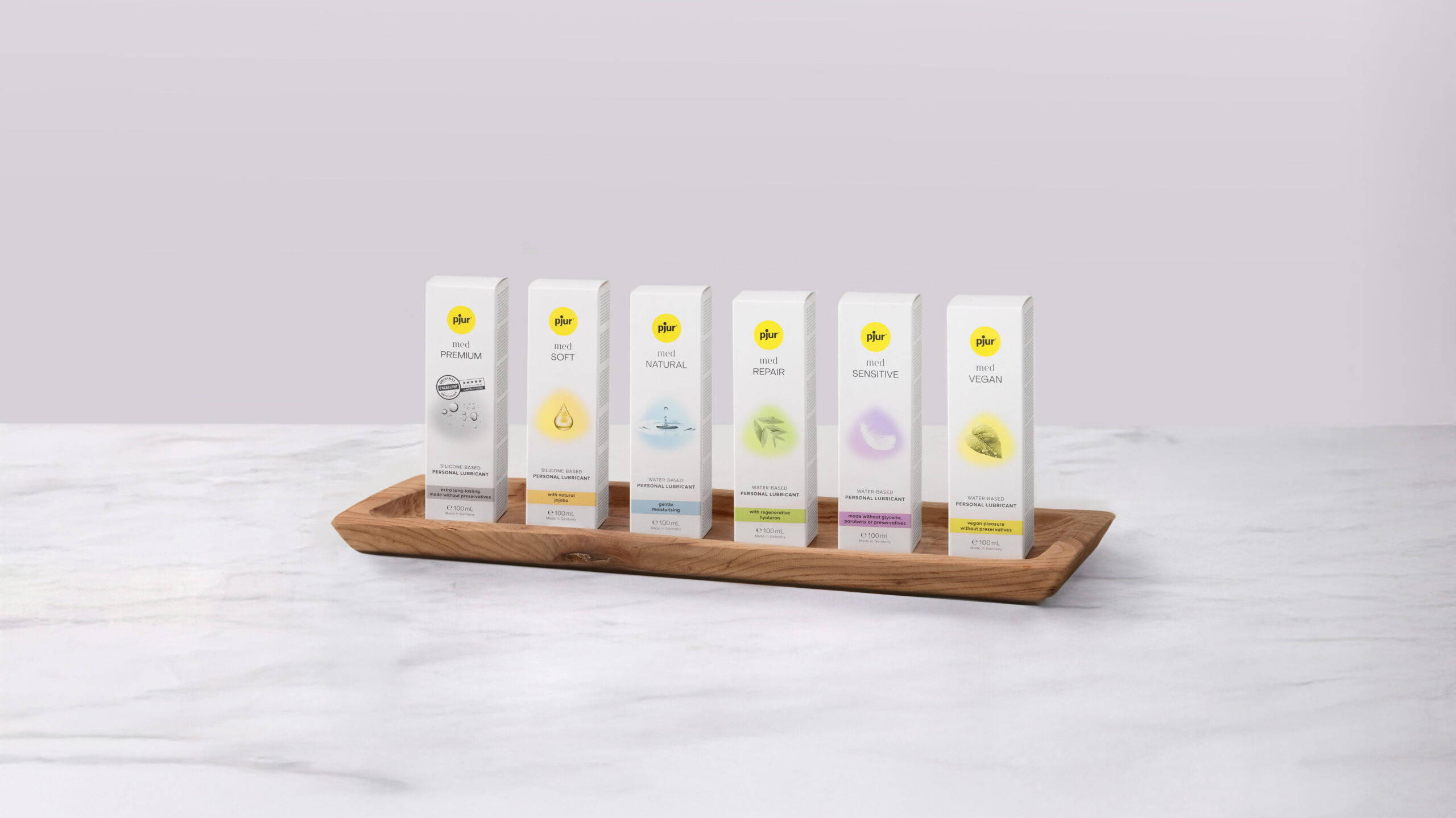
The pjur med range includes several hormone-free lubricant formulations designed to meet different needs and help relieve vaginal dryness.
The water-based pjur med SENSITIVE*² has been developed for sensitive skin and mucous membranes in the intimate area. It contains no glycerine, parabens or preservatives. pjur med REPAIR*³ is also water-based and contains hyaluronic acid, which is known for its water-binding properties.
pjur med PREMIUM offers a silicone-based formulation for dry and highly sensitive mucous membranes. It contains no preservatives and is characterised by particularly long-lasting lubrication. Thanks to its concentrated formulation, a small amount is often enough to create a lasting lubricating layer and reduce uncomfortable friction.*4
Which formulation is most suitable depends on individual symptoms, personal needs and tolerance. If there is any uncertainty, or a history of sensitivity to particular ingredients, advice from a doctor or pharmacist can help with choosing an appropriate product.
Dr. med. Britta Kühlmann also highlights the importance of selecting products carefully: “During menopause, the skin and mucous membranes in the intimate area can become more sensitive. This makes it all the more important to consider a lubricant’s ingredients and how well it is tolerated. There is no single formulation that is equally suitable for every woman. What matters is finding a product that meets individual needs.”
How to Incorporate Lubricant into Daily Intimate Care
Mindful intimate care does not need to be complicated or follow a rigid routine. When vaginal dryness is present, suitable medical lubricants can be used daily or occasionally, depending on individual needs, to relieve discomfort and support intimate wellbeing. The important thing is that their use feels appropriate to the individual and fits easily into everyday life.
When it comes to intimate hygiene, less is often more. Excessive cleansing is unnecessary and can further irritate sensitive skin. For external intimate hygiene, gently cleansing the vulva is generally sufficient. Frequent washing and vigorous rubbing should be avoided, particularly when dryness and sensitivity are already present.*6
A gentle approach is equally important when applying lubricants to the sensitive intimate area. Products should always be used according to their instructions. With particularly long-lasting silicone-based formulations, a small amount may be sufficient. If burning or new irritation occurs, use should be discontinued. Persistent symptoms should be assessed by a healthcare professional.*2 & 3
Intimate Wellbeing Has No Age Limit
Menopause is a natural stage of life that can bring physical changes and new needs. But these changes do not necessarily mean giving up comfort, intimacy or a fulfilling sex life. Symptoms such as vaginal dryness do not simply have to be accepted. Understanding what is happening in the body and knowing which options may offer relief can help women take an active role in supporting their wellbeing.
Intimate care is therefore about much more than using individual care products. At its heart is a mindful relationship with the body: one that makes room for personal needs and recognises intimate wellbeing as an important part of quality of life.
Dr. med. Britta Kühlmann concludes: “Intimate health deserves attention at every stage of life, not only when symptoms begin to affect wellbeing. During menopause in particular, it is important to recognise changes in our bodies and take our individual needs seriously. Intimate wellbeing is part of a holistic understanding of health and of making informed, independent choices about our own bodies.”
FAQ
Can I use pjur med lubricants as part of my daily intimate care routine?
Yes. Lubricants in the pjur med range are suitable for daily use and are intended to relieve vaginal dryness. They can therefore be incorporated into a personal intimate care routine. Always follow the instructions for use and the intended purpose of the specific product*2-4
Do I only need to use lubricant when I have sex?
No. When vaginal dryness is present, lubricant can also be part of intimate care outside sexual activity. Whether it is helpful, and how often it should be used, depends on individual needs.*3
How much lubricant should I use for daily application?
There is no single amount that suits everyone. The quantity needed depends on personal requirements and the instructions for the individual product.
Do I need lubricant if I do not experience dryness?
Lubricant is not exclusively for vaginal dryness. Even without existing symptoms, it can be used to complement natural lubrication and make intimate touch more comfortable. Whether and how often to use it is a matter of personal needs and preferences.
Can regular lubricant use support my usual sex life?
Suitable lubricants can reduce friction and relieve dryness-related discomfort during sexual activity. This may make intimate touch more comfortable and help support an enjoyable sex life.*1
When should I seek medical advice about my symptoms?
Medical advice is recommended if dryness persists, affects everyday life or does not improve despite measures already taken. Unusual discharge and bleeding, particularly after menopause, should also be assessed. A medical consultation can help identify possible causes and explore suitable treatment options.

About Dr. med. Britta Kühlmann
Dr. med. Britta Kühlmann is a plastic and aesthetic surgeon out of deep conviction and with an approach that goes far beyond surgery. At the center of her work is the individual with her personality and personal needs. In the field of holistic medicine, Dr. med. Kühlmann takes a holistic approach that considers different aspects of health, physical wellbeing and quality of life. Her range of treatments includes hormone therapies, micronutrient analyses and individually tailored longevity treatments, among other things. She consciously takes the time to do so: time to look beyond the surface, answer questions in detail and carry out every treatment with care and precision. Because no body is the same, medical treatment should never follow a fixed pattern. Through her medical expertise and holistic treatment approach, Dr. med. Kühlmann brings a well-founded and holistic perspective to the hormonal and physical changes during (peri)menopause and their impact on health and wellbeing. For her, it is about far more than outward appearance. A positive body image arises from the interplay of physical health, inner wellbeing and a natural, individual radiance. Dr. med. Kühlmann considers the person as a whole and takes physical changes, health and personal wellbeing equally into account in her treatment. This holistic perspective is particularly valuable during a sensitive stage of life such as (peri)menopause. Her aim is to support women medically soundly, individually and with great sensitivity, with the goal of strengthening health and wellbeing while preserving their own naturalness and personality.
Links
Instagram: https://www.instagram.com/cineolux_dr.britta.kuehlmann/?hl=de
Website: https://drkuehlmann.de/
Podcast on Spotify: https://open.spotify.com/show/6EVOVQUZzzEJgJExf4Oe9B
Sources
*1 The Menopause Society: Genitourinary Syndrome of Menopause, MenoNote, 2025.
https://menopause.org/wp-content/uploads/for-women/MenoNote-GSM.pdf
*2 pjur: pjur med SENSITIVE, Product Informationen und Instructions of Use.
https://www.pjur.com/en/product/pjur-med-sensitive/
*3 pjur: pjur med REPAIR, Product Informationen und Instructions of Use.
https://www.pjur.com/en/product/pjur-med-repair/
*4 pjur: pjur med PREMIUM, Product Informationen und Instructions of Use.
https://www.pjur.com/en/product/pjur-med-premium/
*5 pjur: About Us, Classification of Lubricants as Class IIb Medical Devices
https://www.pjur.com/en/about-us/
*6 Royal College of Obstetricians and Gynaecologists: Skin conditions of the vulva, Abschnitt Tips for care of the vulva.
https://www.rcog.org.uk/for-the-public/browse-our-patient-information/skin-conditions-of-the-vulva/
Medical Disclaimer
The content of this article is intended solely for general information and educational purposes. It has been prepared with the utmost care but does not replace individual medical advice, examination, or diagnosis. If you experience health problems, have questions about sexually transmitted infections, or are concerned about a possible risk of infection, you should seek medical advice. Medical knowledge and recommendations may change over time.